SIDE-EYE
Designing a reflective learning system that transforms observation, qualitative inquiry, and lived experience into actionable design practice.

Project Snapshot
Role
Creative Director, Educational Designer, Visual Systems Designer, Course Designer
Context
Critical Media Literacy course within the Educational Design for Transformative Social Futures undergraduate specialization, Earl Center for Learning & Innovation at Boston University, Wheelock College of Education & Human Development
Focus
Editorial pedagogy, critical media literacy, multimodal learning, speculative media production, visual systems
Format
Experimental digital publication system, podcast concepts, magazine covers, media prompts, critical scripts, visual frameworks
Timeline
Spring semester / course companion prototype
Collaborators
Developed in relation to student discussions, course themes, and emerging classroom needs
Tools
Blackboard Ultra (LMS); Canva; Adobe Creative Suite; Speechify; academic texts and other course material
The Challenge
Traditional assignments often positioned learning as a process of information consumption rather than active meaning-making. SIDE-EYE was designed as an experimental editorial platform that transformed course concepts into interactive experiences—using narrative, visual storytelling, and playful provocation to sustain engagement beyond the classroom.
Designing Alternative Pathways for Engagement
The semester began with less instructional time than anticipated and experienced additional disruptions from weather cancellations and spring recess. Rather than treating missed meetings as deficits to recover, I explored how design could sustain curiosity and create continuity between interruptions.
Potential Semester Rhythm & Learning Continuity

Actual Learning Continuity
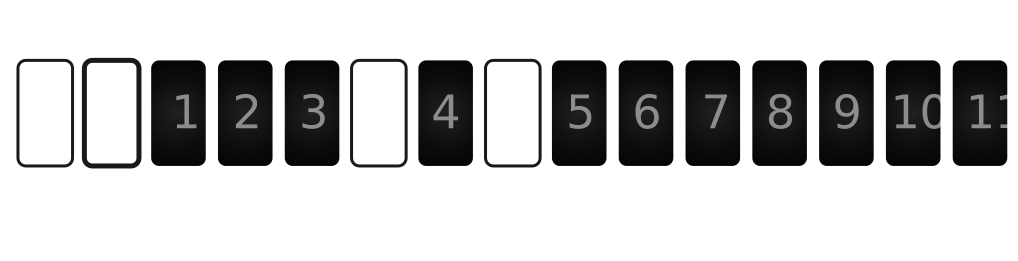
14
Potential Weeks
11
Instructional Weeks
21%
of Continuity Disrupted
Design Response


Rather than treating interruptions as deficits to overcome, I designed alternative pathways that kept ideas alive between meetings. Through podcasts, editorial storytelling, and a multimedia course hub, learning became something students could encounter in the flow of everyday life—through culture, conversation, and creative exploration.
Extending the Learning Ecosystem
While the course operated through Blackboard Ultra, I designed a parallel multimedia ecosystem to support engagement beyond the LMS. A public-facing course website built in Canva translated traditional course materials—including the syllabus, schedule, readings, and assignments—into a more visual and accessible experience. This site became the connective tissue linking classroom discussion, independent exploration, and SIDE-EYE content.
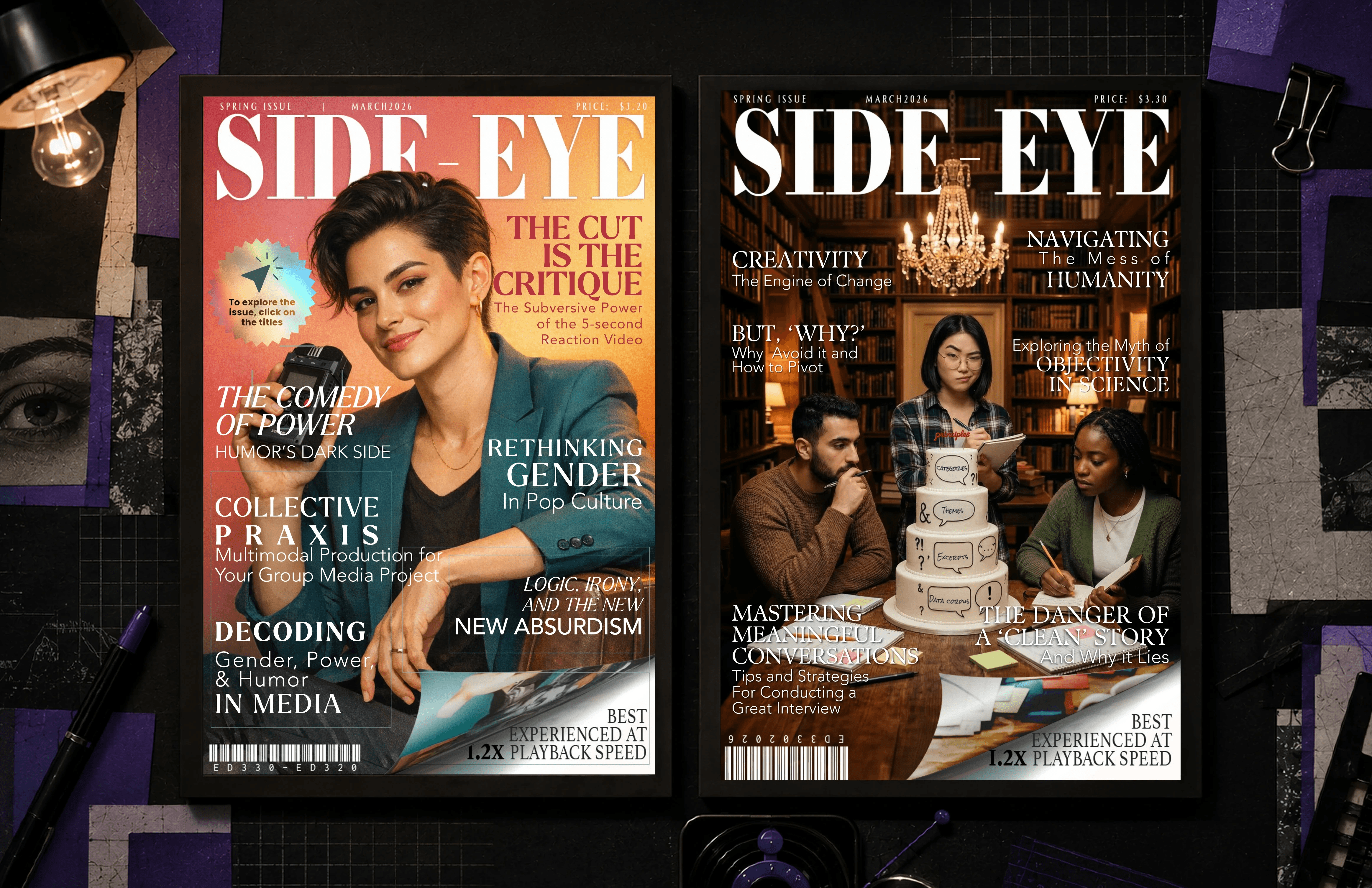
Each issue translated course concepts into a playful editorial experience, combining visual storytelling, critical inquiry, and interactive prompts that invited students to engage ideas beyond the classroom.
SIDE-EYE treated editorial design as a pedagogical system.
Each artifact framed attention differently. A magazine cover could stage a cultural tension. A podcast concept could turn theory into dialogue. A speculative headline could make ideology visible. A visual framework could help students map relationships between media, power, identity, and interpretation.
The system did not ask students to study critical theory.
It invited them to enter it, question it, remix it, and produce with it.
Inside the SIDE-EYE Systems
Rather than relying on a single medium, SIDE-EYE created an interconnected learning ecosystem designed to keep ideas moving beyond the classroom.
Integrated Components
Podcasts translated readings into conversation.
Editorial issues reframed theory through visual storytelling.
Visual frameworks supported reflection and sensemaking.
Creative prompts and discussions invited participation and critique.
Multiple entry points allowed students to engage through reading, listening, conversation, and production.
Integrated Components
Not additional assignments
Ideas moving across media
Participation over consumption
Culture as a vehicle for scholarship
Resilient engagement despite interruptions

Translating Scholarship Into Culture

Impact
Reflection
Looking back, SIDE-EYE taught me that continuity does not necessarily depend on uninterrupted time. In moments when the rhythm of formal instruction fractured, thoughtfully designed media and cultural resources created alternative pathways for curiosity, conversation, and creative engagement. More broadly, the project reinforced my belief that learning technologies are not merely tools for delivering information; they are opportunities to design environments in which ideas can remain alive, travel across contexts, and become part of everyday culture. The principles explored through SIDE-EYE continue to shape how I think about experience design, content strategy, narrative systems, and the relationship between media, participation, and social impact.

Next case study